Clashes at the Top – Goldchess Analyses

2026 World Championship Candidates

To begin with, a question – and by no means a rhetorical one.
Do they – the top chess players, the participants in this tournament – actually know how to play chess?  The answer to this lies in the analyses on our blog.

Our coverage of this tournament goes beyond contemporary chess theory and practice. In it, we highlight the weaknesses and shortcomings in the players’ games, including the winner’s. And we present our own new ideas and concepts.
We bring knowledge to chess that even the grandmasters lack.

That is why they can come to us to further their education. We invite them, and not just them. We also invite other chess players who wish to discover the secrets of the Goldchess style and learn to play chess well and brilliantly.

Goldchess Online Chess Academy – courses for all levels.

https://learnchess.pl

Each set of analyses includes our games, the original for comparison, and positions should anyone wish to find the winning move themselves. Of course, we then play against our educational computer, which can be downloaded from goldchess.com

The games are here:
https://www.goldchess.com/en/other/winnerslist.html#g0_wins

  1. Probably the biggest highlight of our analysis and of this tournament.

Nakamura-Sindarov 0-1

We didn’t want to look for a win for Nakamura here, as he lost decisively. However, knowing that every game has a logical flaw—a pivotal moment where the outcome hinges on a single move—we did look. And we can say with complete certainty and confidence that Nakamura should come to Goldchess to learn how to play chess. Because what he overlooked, in our eyes, disqualifies him. I might even venture to say that no grandmaster in the Candidates Tournament has ever lost like this before. Of course, if Nakamura had played like this…
In set 3, our checkmates and the original for comparison. Night and day. See for yourselves.

  1. Caruana–Nakamura 1–0

A hard-fought win in 83 moves. Caruana undoubtedly plays strongly and has his own style, though in our view there is too much positional play in it. Caruana could do with a bit of a shake-up, perhaps something like the variation we’ve shown, which wins in 52 moves. A different atmosphere, 31 moves faster – that’s something. But that’s not all. In this game, we have a win involving a double queen sacrifice. A chess gem.

But these are uncharted territory for Caruana, and we suspect he wouldn’t be able to play it. And he’s not the only one. We believe, and we’re probably right, that playing this variation is beyond the technical capabilities of most grandmasters. But the young, that is, the younger chess players, will find it. This game will be featured in the Immortal tournament (every Saturday).

  1. Sindarov-Caruana 1-0
    Caruana lost to Sindarov. Precisely because he lacks that certain something we mentioned when discussing the Caruana-Nakamura draw. Greater versatility. The ability to make a brilliant move. Sindarov, with the move 36.Rc5 – which Caruana did not foresee and which took him completely by surprise – forced him to resign. We won’t be looking for a win for Black here, but will instead show other variations White could have played. A draw on move 46; then, with a bit of cunning and wit, Black loses their queen and must resign on move 49. In the third variation, we have a win on move 41. After this game, we can say that Caruana should definitely train further at Goldchess, even if he comes to us anonymously. You’re welcome to join us.
  1. Top-of-the-table clashes

Praggna-Sindarov 0-1

Sindarov is in top form and mowing everyone down. Praggna lost in 40 moves. In the endgame, it was a rout for White. Six pawns to two. Incredible and a rare occurrence. But at Goldchess, we can turn that around. Here, it’s a rout of Black in 34 moves. Why did Praggna lose? I’ll tell you. He lost because, in the position after 18 moves, he played 19.Qc3. So, is Sindarov, the frontrunner, really playing that strongly?

We’ll answer that after reviewing all his games in this tournament. In this game, our win in 34 moves, we show that he isn’t playing strongly and that he can be outplayed. You just have to play, Grandmaster Praggnandhaa.

  1. Praggna-Giri 1-0

Giri lost. But did he really? How illusory it all is. This loss stems solely from an inability to play endgames. And it is not credible in real, proper chess. With Black, we have a draw on move 60, and Giri could also have achieved it without any trouble.

  1. Caruana–Bluebaum 1–0

Caruana won. But in complicated positions, anything can happen.
And in our game, Black won, and in fine style. All it took was gaining a single tempo.

Bluebaum failed to spot this. So if practically all the wins can be called into question, was the Candidates Tournament a serious affair? It seems not. That is to say, in FIDE terms, yes; in chess terms, no. Like two sides of the same coin. And those who won must be aware of this. That it could have gone the other way.

Caruana delivered a beautiful checkmate with a pawn on move 28; we turned the result around on move 29. A move later, but ours is spectacular too. We also show a checkmate on move 32, when White plays a different 24th move.

  1. We’re showing you how to play chess.
    Sindarov’s two draws are a thorn in our side, as they’re spoiling his record.

Sindarov-Bluebaum. Sindarov was unable to win this game. We could. The simplicity and elegance of chess. Our victory is based on the following plan of play:

1.Both rooks must be exchanged. Sindarov’s 29.B:e1 was a mistake. The rook should have been captured with a rook. After the rook exchange, White is left with two bishops, Black with a black-squared bishop and a knight. To have any chance of playing at all, Black must activate and advance the knight. We will then exchange it, simultaneously demolishing Black’s pawn structure. That is our plan. Logical, simple and effective. Sindarov didn’t play it. And we fully executed our plan. White wins on move 41. See how we did it. Magic.

  1. Sindarov–Giri: a draw
    We show you how to play chess

Another good title for this game. Our concepts are foolproof and far superior to those employed by today’s chess players. This is clearly evident in this tournament. Our analysts are ahead of the game. In this game, we can clearly see the weakness of the bishop on d7, which is standing on the king’s file. And this is the theme we exploit to win. In two ways and in a beautiful style that can amaze literally anyone. And a small note. We do not take the d5 pawn like Sindarov (41.R:d5), because then Black mobilises his pieces to defend it, allowing us to calmly carry out our plan.

9. Esipenko–Sindarov: Draw
Another draw, this time against the bottom-placed team. An outsider taking half a point off the leader feels like half a defeat. But Esipenko played this game very strongly and, to be honest, Sindarov was rather lucky to secure the draw. It could have been worse. We found a mate on move 47 in our analysis, but only after a great deal of struggle and trial and error. It was like looking for a needle in a haystack. That is why we believe that neither Sindarov nor any other chess player in the world will find this variation during the tournament. Or perhaps no one will find it at all. We’ll find out in the Immortal tournament. In addition to the prize, the winner will receive the title of Immortal Genius.
A final note. To win a game, you must surprise your opponent with something. And this game is a prime example of the truth of that statement. That surprise is Black’s forced capture of the queen.

10. Bluebaum-Sindarov draw
Sindarov’s fourth draw. Probably fatigue, and his playing strength has waned. He still has an advantage over the runner-up, but he must conserve his strength for the finish so as not to lose that advantage. The drawn position has essentially persisted since the start of the game, and so they proceed to the endgame. Equal pawns, equal pieces. Breaking this balance is extremely difficult. But not impossible. We broke this drawish zugzwang and have wins on move 52. That’s what Sindarov lacked in this game. The key to victory lies in Black’s 31st move.

11. Sindarov–Praggna 1–0
It looks as though Sindarov will see this victory through to the end. In the 10th round, he beat Praggna and extended his lead over Giri to 2 points. We’re keeping our fingers crossed.
P.S. We’re not looking for a win for Praggna here. At Goldchess, we teach you to play beautifully and brilliantly. So we’re showing how Sindarov could have ended this game differently (he played 52.Qd8). Take a look at our variation.

To be continued.

Our other (non-course) educational resources:

The book ‘500 Goldchess Games’, in Polish and English

https://500.goldchess.com/en/product/500-goldchess-games/

Our tournaments
https://www.goldchess.com/en/other/tournaments.html

We invite you to learn.


Get to know Goldchess…

I would venture to say that in today’s chess game, the aim is to defeat your opponent’s mind and score a point. In our game, Goldchess, the aim is to actually win at chess. It seems the same, but it is not.

I would also venture to say that all the games played so far are unbelievable wins, because in each of them we can show a different, better game by the opponent, the chess player who lost, and reverse the result.
Our latest book, ‘500 Goldchess Games’ and the 10-hour chess course, offer a new, fresh perspective on chess. They will surprise even the best. No one plays like this today.
For a full understanding, I can only add that the games in the current 10 million chessbase, compared to the Goldchess games, are chess from a bygone era.
This also applies to today’s chess learning programmes used  by coaches around the world. A bygone era.

We invite you to discover new ideas and a new quality of the royal game. Only with us. Our book ‘500 Goldchess Games’:

https://500.goldchess.com/en/product/500-goldchess-games/

Our online course in English, Polish and Spanish:

Log in – GoldChess Chess Academy

https://learnchess.pl/login

We invite you to join us.

Platinum Certificate of Professional Chess Trainer

Fischer-Robatsch 1-0.Fischer wins in 20 moves. Did Fischer play so strongly, or did Robatsch play so poorly? We answer. It is 1962. For Fischer, it is a breakthrough year, when he significantly improved his level of play. But, you know what? This game made us laugh. Fischer’s greatness… it can all be blown away like a candle flame.

Our computer is no Fischer, but our variations definitely surpass Fischer’s play. In them, Robatsch rises above Fischer high, very high. Thus, this game debunks the myth of the greatness of grandmasters. Simply put, others played weaker. And today, our analyses show that the greats did not play so strongly that the outcome of their games could not be reversed. A long time ago, one of the most famous chess theorists and authors of chess aphorisms, Siegbert Tarrasch, said: ‘To win, you don’t have to play strongly. You just have to play better than your opponent.’

At Goldchess, this is outdated and no longer applies. It has lost its power. Because in our definition, that’s not what chess is about. For us, winning means showing something in chess, not winning for the sake of winning. Such games are meaningless. For chess achievement, chess thinking and the development of chess. And this Fischer-Robatsch game is an excellent example of this. For this game, won with black, you can obtain the highest Platinum Certificate of Professional Chess Trainer. Of course, after winning silver and gold earlier.
A game of chess is a creative endeavour. If you are not being creative, you should consider whether you should continue playing chess.

https://www.goldchess.com/en/other/winnerslist.html#chess-crazy

Goldchess exam for first-level chess trainer

4 levels of chess coach qualification.
Our website features a qualification test-exam for coaches, which, once passed, entitles the chess player to obtain a Level I Chess Coach Certificate.
We estimate that 90% of chess ‘coaches’ will not obtain our certificate. What does this mean?
1. Generally speaking, that they are unqualified or insufficiently qualified, since they are unable to win a position against an educational computer with a playing strength of 1500 Elo.  In other words, they are unreliable.
2. That they can teach something about playing chess, but they are certainly not able to train a true master.

After the establishment of the Goldchess school, the ranking position obtained at the FIDE institution is no longer a reliable or full-fledged qualification to practise as a chess coach.
This test is the first level of initiation.
We have 4 levels. Those who pass this basic test will gain access to the next game-task and will be able to obtain a Level II Chess Coach Certificate. This is followed by levels III, IV and V. Three levels are technical, the fourth is educational, and the fifth is the final coaching exam. The strength of the Goldchess educational project is that no chess computer can help anyone win the test tasks.

Do you have a coach who teaches you how to play chess and charges you for it? Ask them if they have a Goldchess coaching certificate and you will know for sure. They either have the qualifications or they don’t.
The first degree certificate (game number 5) can be obtained here:

https://www.goldchess.com/en/other/winnerslist.html#chess-crazy

Stockfish

I have always said that Armenian chess players are brilliant, even genius. First there was Sargis Manukyan, then Armenak Yeghiazaryan and the younger players, Alex Nurijanyan, Arman Ghevondyan and Sahak Petrosyan. Those who played in Goldchess and made a name for themselves have repeatedly shown what they are capable of. They are not in the top 100, but the best chess players in the world could learn a lot from them. They have made a huge contribution to the development of Goldchess by sending their own brilliant and often genius solutions and variations. Today, Sahak found our variation from the Stockfish-Houdini position, mate with three queen sacrifices. After the third sacrifice, which was not accepted, we can already checkmate, but we can also add another 4 sacrifices and then checkmate. This is a modernisation of Stockfish’s game. And based on this game, we can safely say that Stockfish will only play like this in about 100 years, because it is still far from matching the capabilities of the human brain.
 Congratulations to Sahak, the prize and the title of Goldchess Genius. See this game.
https://www.goldchess.com/en/other/winnerslist.html#livepuzzlegmc_wins

Our wonderful world

Dear chess players, the world is divided into rich and poor, that is, rich and poor countries. And it is easy to classify this in chess. In Europe or the USA, every chess player has a computer or laptop.

We point this out because it is here (on the Goldchess website) that you need a computer to participate in online tournaments.

So yes. In 3rd world countries, one in 10 chess players has a laptop. In 4th world countries, one in a hundred.

In 5th world countries, one in a thousand. Get your bearings and you’ll know what country you live in and how far you are from real civilisation. I’m not going to make a list and order here now, I’ll just say that two well chess-developed countries, India and Russia, are at the far tail in this classification.

On the road to excellence

Superbet Romania 2025
Lagrave-Gukesh 1-0

This win is pure fiction. Like, indeed, most of the games in this and every other tournament. Only a point for Lagrave and nothing else is obvious. Modern tournament chess has it that winning games are not justified in chess analysis. That is, a fictitious win. But this is what both organisers and chess players are content with. It is like a training game, and yet seriously, as the result goes out into the world. And there is virtually no solution in sight. How could this situation be fixed or cured.

 Some alternative is Goldchess. Here, in tournaments from a given position and against a computer that can be played because it is not playing at 3000 Elo level, but 1500, in most cases such flukes and runaway wins do not happen. To win, you have to show extraordinary and effective chess. Of course, the computer also has its weaknesses and makes mistakes, but nevertheless, if one compares the two types of tournaments, traditional and Goldchess, the error rate in traditional is 90%, in Goldchess only 10%. This means that Goldchess is more correct and therefore more valuable as chess stricto sensu and more educational, in the full and proper sense of the word.

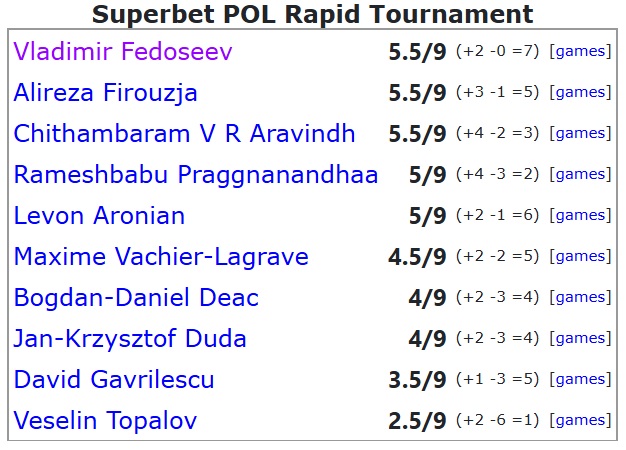
Superbet Poland Rapid Tournament, April 2025

Duda-Fedoseev 0-1

The situation when in the 51st move white has 2 rooks and a pawn and black has 2 rooks and 3 pawns is not a comfortable one. However, we have a draw in the 70th move, and a real draw position is reached in the 65th move. It follows that Duda lacked a good concept. Not necessarily ours.
We do not consider any more of his games, as he lost as many as 3 of them and fell out of our interest.
In the end Fedoseev came back on top and won this tournament. Second Alireza.

Our heroes who lost only one game each in this tournament are Alireza and Aronian. And here is an interesting observation. They both lost to Aravindh, who finished 3rd, but also lost 2 games, to Lagrave and to Pragna. As we can see, Superbet is the kind of tournament where anyone can beat anyone.

Aravindh-Firouzja game 1-0

Firouzja defended until the 87th move and we are not sure if he rightly surrendered the game. We see the possibility of a draw and do not see a loss. Unless Alirezia ran out of time.

Aravindh-Aronian 1-0

Aravindh played this game very strongly. Or Aronian poorly. Although white did not play the strongest (20.Nc2) there was little chance of black winning after black’s move 20….a5. In our opinion this was a mistake that consequently gave white a free winning pawn. Instead of playing 20…a4, they should not have counter-attacked here, should not have rushed the resolution of the pawn issue, but should have left white with the initiative and the effort of forcing the pawns, which would have taken both time and commitment on the queen wing of their pieces. 
We won Aronian’s game with 3 variants. One with the sacrifice of the queen. A chess masterpiece. If Aronian played like that, he would be world champion. But he can still become one. He just needs to come to Goldchess and learn to play chess perfectly.
Ps.
After three days, the organisers changed the order of the table and eventually Aravindh won this tournament.

Telephone chess players and Fischer’s chess

At a time when the telephone has become an essential but also a curse, Goldchess is a saviour.
In our tournaments no one will play from a phone, a chess player must have a computer. This cuts off phone chess players and quite rightly so, because you can’t really play serious chess on the phone. Chess on the phone is a profanation of the royal game and a cheapening of it, to the obvious detriment of its quality. At this point we are consciously giving up on the number of players who can play with us, but given that the games played on the phone are poor quality games, practically chess spam, and the chess players who play them are spam chess players, we are able to get over this quantitative loss. To conclude, we need champions, or those who want and aspire to become champions. And we can help them in this.

I would also like to refer to the so-called Fischer chess, which is a new fashion and to which even Carlsen himself has succumbed.

In our opinion, it is a chess fiction, a total misunderstanding. By comparison, Goldchess is 100 times more valuable, spectacular and educational. Smart. And they contribute a lot to the development of chess.
Goldchess , as the artificial intelligence formulating its own conclusion wrote in the opinion, is likely to become a worldwide phenomenon. Fischer’s chess started quickly and will end quickly. They are, as I said, a distortion and do not contribute any value or anything to the development of real chess. In a few years they will be gone, whereas Goldchess will be part of the chess reality for decades and who knows if not centuries to come. For this reason, I can say that it is already impossible to be a good chess player without knowing the techniques, style and knowledge of Goldchess. Goldchess, a real chess trend. But not for everyone. Only for chess players who take chess seriously. And, in an unintentional, elitist way. Only for chess players who own computers.

Goldchess opinion

Capablanca voiced an opinion on the superiority of endings over debuts. To this day, this causes controversy among supporters of debuts. Like Karpov, Kasparov or Carlsen. Although Carlsen doesn’t make a statement about which is more important, he only says that when learning to play chess, he spent a lot of time on debuts.

But. Capablanca did not say that he negates debuts and their importance. He said that he prefers to devote time or more time to endings as debuts. That they are, for him or in his opinion, more important. This does not mean that he thought it was possible to win at chess without an elementary knowledge of debuts.

We announce a third, our theory. In our opinion, the middle game, after the debit, is the most important. That’s when real chess begins. And the debut? You should come out of the debut without losing a piece or a pawn and with the pieces well set up for attack. Of course, an elementary knowledge of these is absolutely necessary. A lesser knowledge of them will only result in the opponent using up 2 minutes for his moves in the debut, and, knowing debuts less well, 10 minutes. And that’s basically it.

ps.
Today, before the 11th game referring to the statement in the previous post (Fb website) that Gukesh will attack with white, I wrote:

I assume that Gukesh will attack in the 11th game, playing with white. And this is what happened.
Gukesh won with white. Of course, this is not the end of the match, but he leads by one point.